
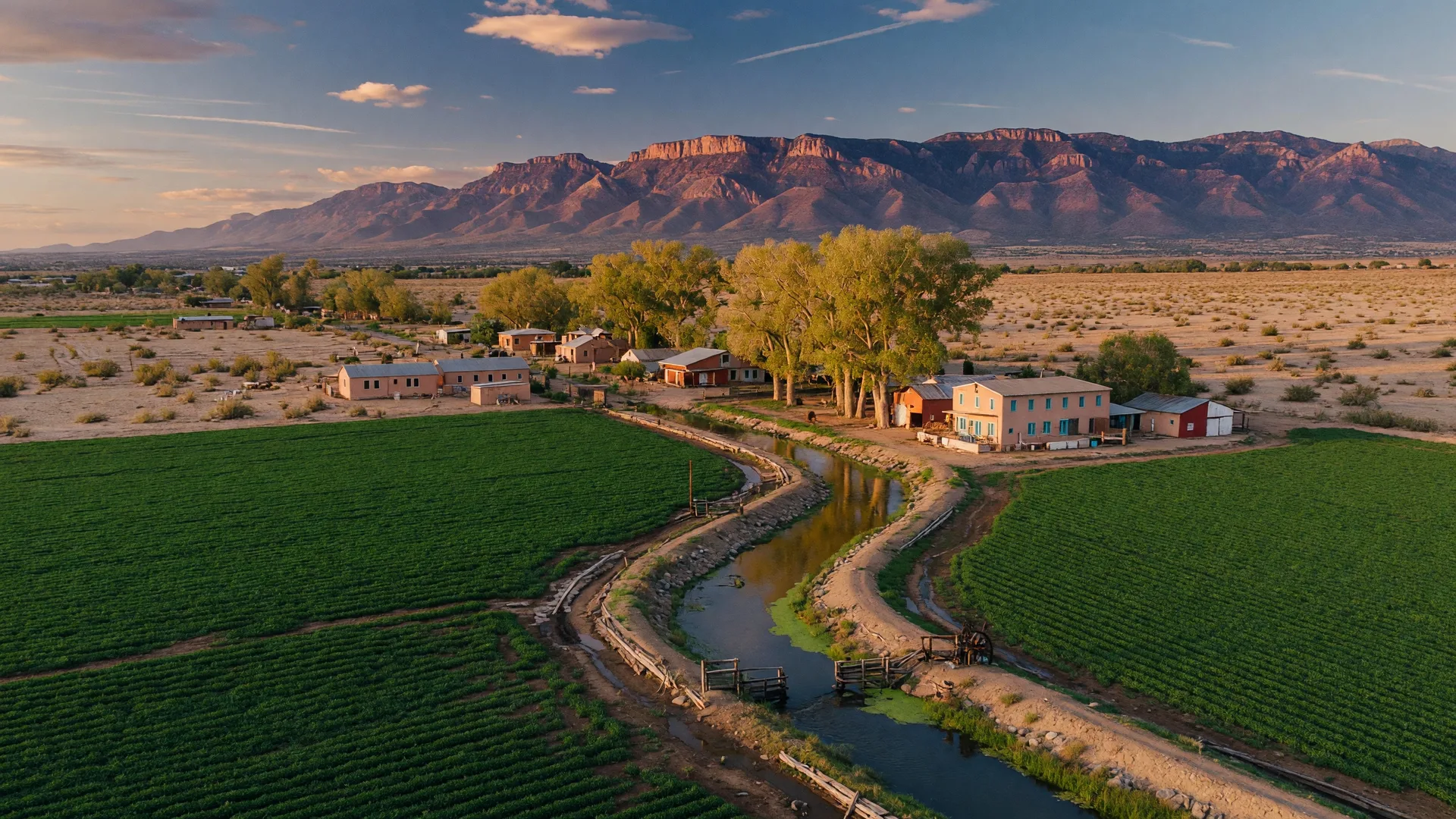

In most states, water is assumed. In New Mexico, it is not. Water rights are one of the most significant and least understood factors affecting property value in the state. A property with strong, adjudicated water rights can be worth dramatically more than one without and the difference can run into the hundreds of thousands of dollars.
This post explains exactly how water rights affect property values across different types of real estate in New Mexico. Whether you are looking at irrigated farmland in Corrales, a horse property in North Albuquerque Acres, a ranch in Placitas, or a suburban home in Rio Rancho, understanding this connection is critical to making an informed purchase or sale.
For a broader overview of how water rights work in New Mexico, including the prior appropriation doctrine and priority dates, read our complete New Mexico Water Rights resource page and our overview post What Are Water Rights in New Mexico?
1. The Water-Value Connection
The connection between water rights and property value in New Mexico is direct and measurable. Unlike states where municipal water is universally available, New Mexico properties outside of city limits depend on wells, acequias, or irrigation districts. Even within city limits, the underlying water rights or the lack of them can affect what a buyer can do with the land.
A property with senior, adjudicated water rights offers security that junior or unadjudicated rights cannot match. Buyers pay a premium for that security because it means the property can sustain its intended use farming, ranching, gardening, or simply maintaining a green landscape through the hottest, driest months. A property without confirmed water rights, or with rights that are junior, severed, or clouded by legal uncertainty, carries higher risk and therefore lower value.
The value gap is most visible in agricultural and rural properties, where water rights can represent 30 to 50 percent of the total property value. But the principle applies across all property types. Even a suburban home lot in a community with acequia access may command a higher price than a comparable lot without it, because the buyer gains the ability to irrigate a garden or maintain fruit trees that would otherwise require expensive municipal water.
2. How Water Rights Increase Value
Not all water rights are equal. The specific characteristics of a property's water rights determine how much value they add. Here are the key factors that drive value upward:
- Senior rights provide water security. The older the priority date, the more secure the water right. Pre-1907 rights and other senior rights are almost never curtailed during drought. This security is valuable because it protects the property's ability to produce food, support livestock, or maintain landscaping even in severe dry years. A farm with a pre-1907 irrigation right will produce every year. A neighboring farm with a junior right may not. That difference is directly reflected in the sale price.
- Irrigation rights enable agricultural use. Irrigation rights allow the landowner to grow crops, hay, or pasture. This is what makes farmland productive and what gives horse properties their ability to support feed. Without irrigation rights, agricultural land is limited to dryland use or recreational purposes, which typically command a significantly lower price per acre.
- Adjudicated rights reduce legal risk. An adjudicated water right has been confirmed by a court through a formal legal proceeding. The court has decreed the priority date, the quantity of water, the type of use, and the location. This legal certainty means there is almost no risk of the right being challenged or reduced in the future. Buyers pay more for this certainty.
- Well permits add convenience and independence. Properties with domestic well permits are not dependent on municipal water systems. This independence is attractive to buyers who want control over their water supply, especially in rural areas. However, not all well permits are created equal. A well with a strong yield, good water quality, and a valid permit in a declared basin adds significant value. A well with a marginal yield, water quality issues, or a permit in a fully appropriated basin may add less value or even be a liability.
For a deeper dive on pre-1907 rights and why they are the most valuable in New Mexico, see our post Understanding Pre-1907 Water Rights in New Mexico.
3. Property Types and Water Value Impact
The impact of water rights on property value varies significantly by property type. Here is how different types of real estate are affected:
Farm and Ranch Land
This is where water rights have the most dramatic impact. On irrigated farmland, water rights can represent 30 to 50 percent of the total property value. A 40-acre farm with senior irrigation rights may be worth $800,000, while the same acreage without water rights might sell for $400,000 or less. The water rights are literally worth more than the land itself in some cases. For ranches, stockwater rights that support livestock grazing are similarly essential. A ranch without stockwater rights can only support a fraction of the animal units that a ranch with senior stockwater rights can carry.
Horse Properties
Horse properties in areas like North Albuquerque Acres, Corrales, and Sandia Heights depend on irrigation rights for hay and pasture. Without irrigation, maintaining enough pasture to support horses year-round is nearly impossible. A horse property with acequia or well irrigation rights commands a significant premium over one without, because the buyer can keep horses on the property without buying in hay. For many horse owners, this is a non-negotiable feature.
Residential Properties
For most residential properties in Albuquerque and Rio Rancho that are connected to municipal water, the water rights issue is less visible because the city handles water delivery. However, the cost of municipal water versus well water affects long-term ownership costs, and homes with a private well in areas where municipal water is expensive may be more attractive to some buyers. In historic areas like Corrales and Los Ranchos de Albuquerque, acequia access is a major selling point that adds value to residential properties. Buyers pay more for a home with acequia rights because they can irrigate their gardens, orchards, and landscaping without paying city water rates.
Development Land
For vacant land intended for development, water availability determines what can be built and at what density. Land with confirmed water allocation can be subdivided and developed. Land without water rights may be limited to a single home with a domestic well, or may not be developable at all. The value difference can be enormous. A 10-acre parcel with water allocation for 20 homes is worth many times more than the same parcel without any water allocation.
Luxury Estates
Acreage with water rights commands premium pricing at the luxury end of the market. High-net-worth buyers seeking estates in Sandia Heights, North Albuquerque Acres, or Four Hills are often willing to pay significantly more for properties with established irrigation systems, acequia access, or productive wells. These buyers value the lifestyle that water enables: lush grounds, gardens, orchards, and the ability to create a private retreat. A luxury estate with documented water rights can sell for 20 to 40 percent more than a comparable estate without them.
4. What Diminishes Water Value
Just as strong water rights add value, certain water-related issues can significantly diminish a property's market price. Here are the most common value-diminishing factors:
- Junior rights with poor priority dates. A water right with a 1980s or later priority date in a fully appropriated basin is at high risk of curtailment during drought. Buyers discount these properties because the water supply is uncertain. The discount can be 20 to 40 percent compared to a similar property with senior rights.
- Non-adjudicated rights with unclear documentation. Water rights that have not been confirmed by a court carry legal uncertainty. A buyer faces the risk that the right could be reduced or eliminated in a future adjudication. Properties with unadjudicated rights typically sell at a discount because the buyer assumes this risk.
- Severed rights not transferring with the land. Perhaps the most damaging situation is when water rights have been severed from the property and sold separately. The land itself may look the same as a neighboring parcel with full water rights, but its utility and value are fundamentally reduced. Severed water rights can reduce property value by 30 to 50 percent or more, depending on the intended use.
- Drought-prone areas with declining water tables. In areas where groundwater levels are dropping and wells are going dry, property values suffer. Buyers factor in the cost of deepening wells, drilling new ones, or hauling water. Properties in these areas may sit on the market longer and sell for less than comparable properties in areas with stable water tables.
- Overallocated basins. In basins where more water rights have been issued than there is physically available water, junior rights holders face ongoing curtailment risk. Properties in these basins are less attractive to buyers, who prefer water security over uncertainty.
For more on the risks of severed water rights, see our post Do Water Rights Transfer When You Buy Property in New Mexico?
5. Case Examples from the Market
Real-world transactions illustrate the value gap that water rights create. Here are two examples that reflect patterns I see regularly in the New Mexico market:
Example 1: Corrales Acequia Property
A 10-acre property in Corrales with acequia rights and a domestic well sold for approximately $150,000 more than a comparable property across the road without acequia access. Both properties had similar homes and similar lot sizes. The difference was entirely in the water rights. The buyer, who planned to keep horses and maintain a large garden, was willing to pay a premium for the security of acequia irrigation. The property without acequia access required a different irrigation strategy that was more expensive and less reliable, making it less attractive to the same buyer pool.
Example 2: Estancia Valley Ranch
A ranch in the Estancia Valley with pre-1907 water rights appraised significantly higher than neighboring properties that held only junior groundwater permits. The appraiser specifically noted the priority date as a value driver. While the junior-rights properties faced uncertainty about water availability in drought years, the pre-1907 rights property offered ironclad water security. The appraised value difference was substantial enough to affect financing terms, insurance rates, and the eventual sale price.
6. How to Research Water Rights Before Making an Offer
If you are considering a property where water rights may affect value, take these steps during your due diligence period:
- Ask the listing agent about water rights. The listing agent should be able to tell you whether the property has water rights, what type they are, and whether they are included in the sale. A knowledgeable agent will have this information ready.
- Review the title commitment attestation. The water rights attestation in the title documents will show whether water rights are appurtenant, severed, or encumbered. This is your first written evidence of what is and is not included.
- Check with the Office of the State Engineer. Search the OSE records for water rights, well permits, and filings associated with the property. This will tell you what is officially on record and whether any issues exist.
- Request a professional water rights evaluation for high-value properties. For properties valued at $500,000 or more, or for any property where water rights are a significant part of the value, a professional water rights evaluation by a water rights attorney or engineer is money well spent. The cost is a fraction of what a mistake would cost you.
For a comprehensive due diligence checklist, visit our New Mexico Water Rights resource page.
7. Working with a Knowledgeable REALTOR
Water rights are complex. A REALTOR who understands them can help you identify value, avoid pitfalls, and negotiate from a position of knowledge. This is not a niche specialty. In New Mexico, water rights affect property values across almost every market segment, from suburban homes with acequia access to large agricultural operations.
When you work with me, I review water rights documentation for every property we consider. I help you understand what the water rights attestation means, what questions to ask the seller, and whether the asking price fairly reflects the water rights situation. If the property has strong, senior, adjudicated rights, I make sure we factor that into our offer. If the rights are junior, severed, or uncertain, I make sure you understand the risk before you commit.
Water rights are not an afterthought in New Mexico real estate. They are a core factor that can shift a property value by tens or hundreds of thousands of dollars. Having an agent who knows how to evaluate them is not a luxury. It is a necessity.
To learn more about how I help buyers and sellers navigate water rights, visit my About page or explore the buying guide.
Water rights can shift a property value by tens or hundreds of thousands of dollars. Let us make sure you know what you are getting.
Contact Nysha Lynn Livingston at 505-218-1851 or NyshaSellsRE@gmail.com.
Also explore: buying a home · selling your home · contact Nysha