
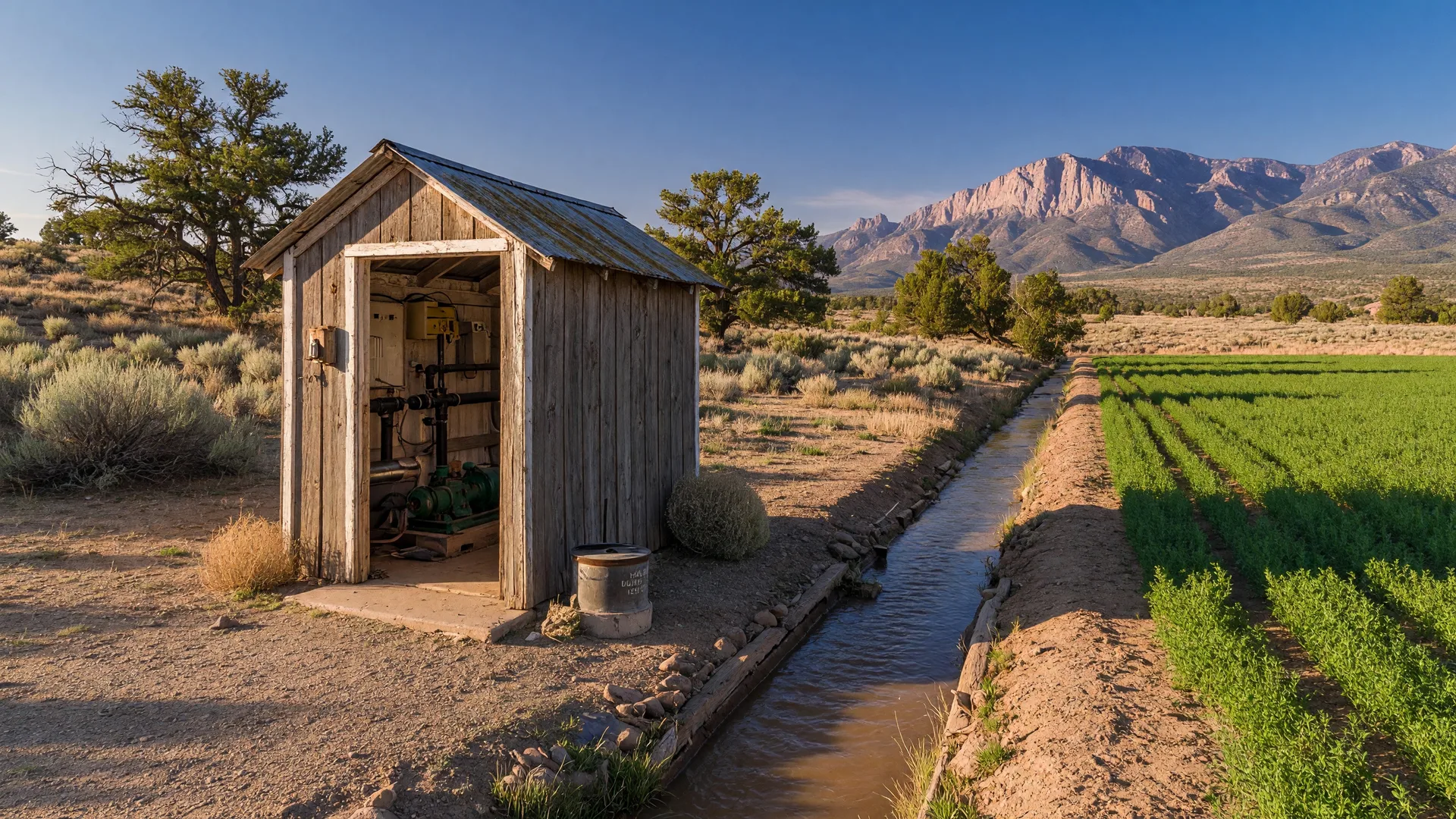

Every buyer looking at rural or semi-rural property in New Mexico needs to understand the difference between a domestic well and irrigation rights. These are two entirely different legal constructs, and confusing them can lead to expensive surprises after closing.
This guide explains what each type of water right allows, how they differ, and what every buyer should ask before purchasing property in Albuquerque, Rio Rancho, Corrales, Placitas, or any other New Mexico community with well water.
For a broader overview of water rights in New Mexico, including the prior appropriation doctrine and priority dates, read our complete New Mexico Water Rights resource page and our posts What Are Water Rights in New Mexico? and Acequia Rights Explained for Homebuyers.
1. Domestic Wells : What They Are
A domestic well permit (formally a 72-12-1 permit under New Mexico law) allows you to pump groundwater for household use. This includes drinking, cooking, bathing, laundry, and sanitary purposes. These permits are tied to the property and cannot be sold separately from the land.
A standard domestic well permit typically allows up to one acre-foot (about 325,850 gallons) of water per year for a single-family home. This is enough for an average household's daily needs with some small outdoor watering, but it is not enough for large-scale irrigation.
The 72-12-1 rule is critical: under New Mexico law, the water right tied to a standard domestic well permit cannot be severed, transferred, or sold independently of the land. It is appurtenant to the specific property and parcel it serves. When you sell your home, the domestic well permit stays with the property.
Domestic wells are common throughout New Mexico, especially in rural areas, foothills, and communities without municipal water service. Properties in Placitas, Sandia Heights, the East Mountains, and many parts of Rio Rancho rely on domestic wells. While the well provides independence from city water utilities, it also comes with legal limits that many buyers do not fully understand.
2. Irrigation Rights : What They Are
Irrigation rights allow you to use water for agricultural purposes: watering crops, hay fields, pastures, orchards, and large-scale landscaping. These rights are a separate legal entitlement from domestic well permits and operate under a different regulatory framework.
Most irrigation rights in New Mexico are surface water rights delivered through acequias, ditches, or canals. The oldest and most valuable irrigation rights date back to the Spanish colonial period and the territorial era, with priority dates that make them nearly immune to curtailment during drought. Some irrigation rights also come from groundwater through irrigation wells, but surface water is the dominant source for agricultural irrigation in the Rio Grande Valley.
Irrigation rights are measured in acre-feet, not gallons. A single acre-foot is roughly 325,850 gallons. Agricultural operations may require anywhere from 2 to 5 acre-feet per acre per year, depending on the crop, climate, and irrigation method. A small horse property with pasture might need 3 to 6 acre-feet annually. An alfalfa field might need 4 to 5 acre-feet per acre.
In the Albuquerque metro area, irrigation rights are concentrated in the Rio Grande Valley communities: Corrales, Los Ranchos de Albuquerque, the North Valley, and the South Valley. Properties in these areas often have acequia access or ditch rights that provide irrigation water during the growing season, typically April through October.
3. Key Differences
The table below summarizes the critical differences between domestic wells and irrigation rights in New Mexico:
| Category | Domestic Well | Irrigation Rights |
|---|---|---|
| Purpose | Household use: drinking, cooking, bathing, laundry, sanitation | Agricultural use: crops, hay, pasture, orchards, large-scale landscaping |
| Source | Groundwater (underground aquifers pumped via a well) | Surface water (acequias, ditches, rivers) or irrigation wells |
| Volume | Limited to approx. 1 acre-foot/year for a single-family home | Measured in acre-feet; varies from a few to hundreds per year |
| Regulation | Well permit (72-12-1) issued by the Office of the State Engineer | State Engineer decree or adjudication; acequia association bylaws |
| Transferability | Tied to the land only: cannot be sold or transferred separately | Can sometimes be transferred, severed, or sold (with OSE approval) |
4. Why This Matters for Buyers
Many buyers assume their domestic well can irrigate a large yard or horse property. It cannot: not legally. This is the single most common water rights misconception I encounter with clients.
If you are looking at a property with acreage and planning to have horses, grow hay, maintain extensive landscaping, or start a small farm, you need separate irrigation rights in addition to or instead of a domestic well. The domestic well will cover your household needs, but it will not legally support agricultural-scale water use.
Consider this real scenario: a buyer finds a beautiful 3-acre property in Corrales with a domestic well and stunning mountain views. They plan to keep horses and maintain a lush pasture. They assume the well can handle it. After closing, they discover that the property has no irrigation rights. The domestic well permit allows household use only, and the cost of purchasing and transferring irrigation rights can run into tens of thousands of dollars if they are even available.
The consequences of violating a domestic well permit are serious. The Office of the State Engineer can impose fines, issue cease-and-desist orders, and even revoke the permit entirely. If you lose your well permit, you could be left with a home that has no legal water source. This is not a theoretical risk: it happens.
5. Can You Have Both?
Yes. Many properties in New Mexico have both a domestic well for household use and acequia or irrigation rights for the land. This is the ideal setup for properties with acreage.
Having both means you get clean, reliable groundwater for your home while having access to surface water for irrigation. This combination is common in Corrales, Los Ranchos de Albuquerque, and the North Valley, where acequia systems have operated for centuries and many properties also have domestic wells for drinking water.
For horse properties, small farms, and estate lots, having both a domestic well and irrigation rights is the gold standard. The domestic well serves the house, and the irrigation water maintains the land. If you are looking at properties with acreage, this is the combination you should be seeking.
6. What If You Only Have a Domestic Well?
You can still have a beautiful property with only a domestic well, but you need to understand the limits. A domestic well can support:
- All normal household water use for a family
- A small household garden (vegetables, herbs)
- Limited landscaping around the home: a few trees, shrubs, and a modest lawn area
- Water for a few small animals (not a full horse operation)
A domestic well cannot legally support:
- Irrigation of large gardens, orchards, or fields
- Watering extensive pastures or hay fields for horses or livestock
- Filling or continuously topping off a swimming pool
- Commercial agricultural operations of any kind
Many buyers successfully enjoy rural properties with just a domestic well by embracing xeriscaping and drought-tolerant landscaping. Native plants, desert-adapted trees, and gravel or stone ground cover create beautiful, low-water yards that thrive in New Mexico's climate without requiring irrigation rights. If your goal is a sustainable, low-maintenance property, a domestic well alone may be perfectly adequate.
7. The 72-12-1 Rule
The 72-12-1 refers to the section of New Mexico state law that governs domestic well permits. This is the legal framework that every owner of a domestic well needs to understand.
Under New Mexico Statutes Annotated §72-12-1, the water right tied to a standard domestic well permit cannot be sold independently of the land. It is appurtenant to the specific property and parcel it serves. This means:
- When you sell your home, the domestic well permit stays with the property
- You cannot sever the water right and sell it to someone else
- The permit cannot be transferred to a different property
- The water right is part of the real estate, not a separate asset you can trade
This is different from many irrigation rights, which can sometimes be severed, transferred, and sold separately (subject to approval by the Office of the State Engineer). Understanding this distinction is essential when evaluating a property's water rights and their long-term value.
If you are buying a home with a domestic well, the 72-12-1 rule works in your favor: the water right stays with the property and transfers to you at closing. But it also means the seller cannot sell the well water right separately, so you can be confident that the domestic well permit will be part of your purchase.
Frequently asked questions about domestic wells and irrigation rights
Can I expand my domestic well permit for irrigation?
What happens if I use my domestic well for irrigation?
How do I get irrigation rights?
Can I drill a second well for irrigation?
What is the difference between a domestic well and an irrigation well?
Do I need irrigation rights for a small garden?
How can I tell if a property has irrigation rights?
Can I fill a swimming pool with my domestic well?
Let's make sure you know exactly what water rights come with the property you are considering.
Contact Nysha Lynn Livingston at 505-218-1851 or NyshaSellsRE@gmail.com.
Also explore: buying a home · selling your home · contact Nysha