
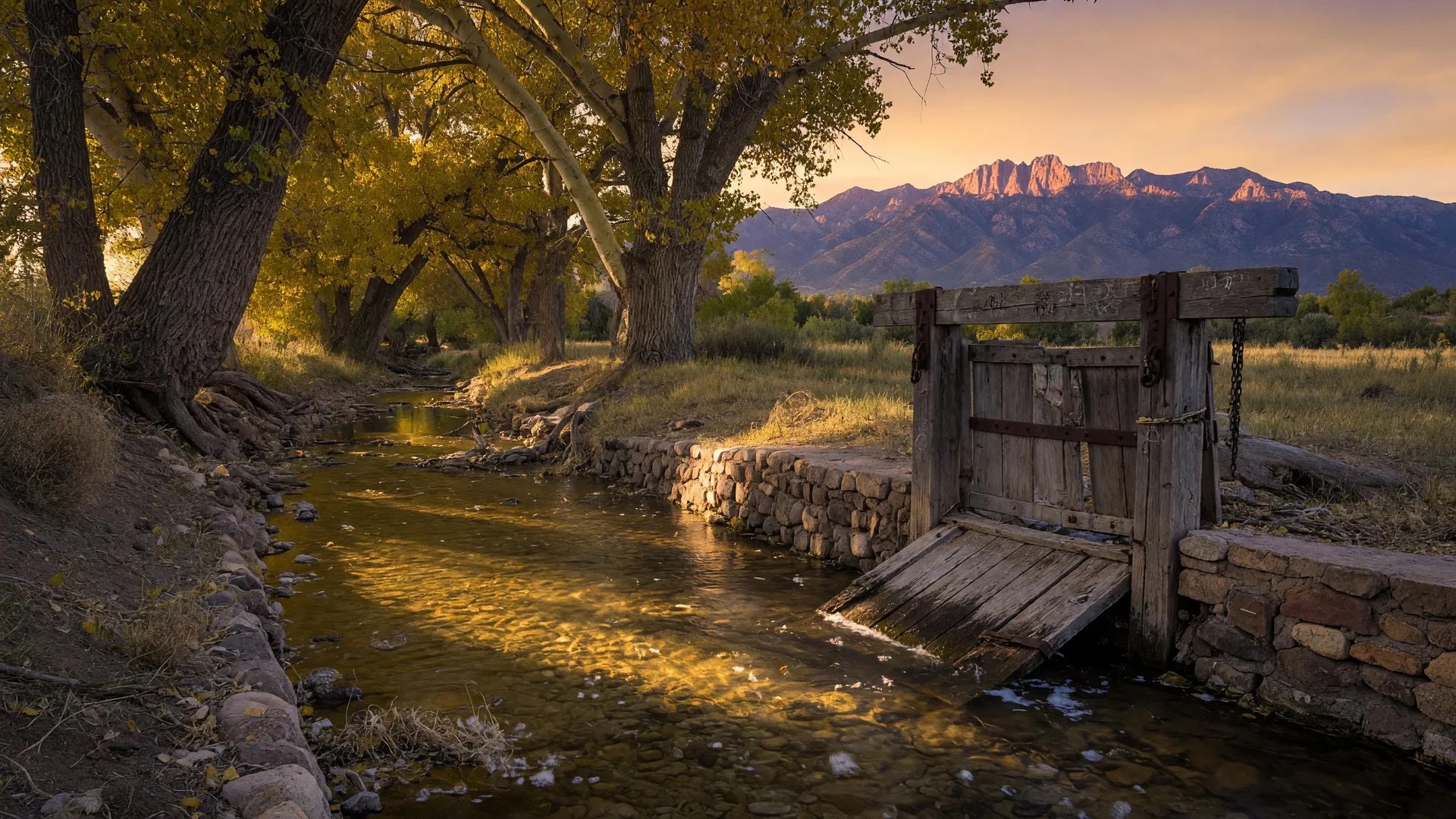

If you are buying property in New Mexico, acequia rights are one of the most valuable and misunderstood features you can encounter. These community-operated irrigation channels have been delivering water to farms, gardens, and horse properties for centuries, dating back to the Spanish colonial era. Yet many buyers, including experienced ones, discover too late that they do not understand how acequia rights work, what they are worth, and what responsibilities come with them.
This guide covers everything you need to know about acequia rights in New Mexico: what they are, how they are governed, how they affect property value, and what every buyer should ask before purchasing a property with acequia access.
For a broader overview of water rights in New Mexico, including the prior appropriation doctrine and priority dates, read our complete New Mexico Water Rights resource page and our post What Are Water Rights in New Mexico?
1. What Is an Acequia?
An acequia (pronounced ah-SEH-kee-ah) is a community-operated irrigation channel that carries water from a river, stream, or reservoir to the land of its members. The word comes from the Arabic as-saqiya, meaning "the water bearer," and the system itself was brought to the Americas by Spanish colonists. In New Mexico, acequias have been in continuous operation for over 400 years, making them one of the oldest water management systems in the United States.
Acequias are not just ditches. They are legally recognized community institutions governed by local ditch associations. Each acequia has a set of bylaws, a board of directors, and a mayordomo (ditch boss) who oversees water distribution and maintenance. The members of an acequia are called parciantes, and they collectively own the right to use the water delivered through the system.
Acequias are a vital part of New Mexico's agricultural and cultural heritage. They are concentrated in the Rio Grande Valley, including areas like Corrales, Los Ranchos de Albuquerque, the North Valley, and the South Valley. Many of these communities were founded around acequia systems, and the irrigation channels remain the lifeblood of their agricultural identity today.
2. How Acequia Rights Work
Acequia members (parciantes) have the right to receive a share of water based on their property's historical allocation. This allocation is typically measured in terms of acre-feet or a percentage of the available flow, and it is tied to the specific parcel of land. The right to water is appurtenant to the land, meaning it stays with the property when it is sold, rather than belonging to the individual owner.
Water is typically delivered during the irrigation season, which runs from spring through fall, roughly April through October. The mayordomo manages the flow of water, opening and closing headgates to deliver water to each parciante's property on a rotating schedule. This schedule is determined by the acequia's bylaws and the mayordomo's judgment, and it can vary depending on water availability, weather conditions, and the needs of the members.
Each acequia is governed by a mayordomo (ditch boss) and a board of directors elected by the parciantes. The mayordomo is responsible for:
- Distributing water according to the acequia's rules and schedules
- Maintaining the ditch and headgates
- Enforcing water use rules and resolving disputes
- Organizing the annual limpieza (ditch cleaning day)
- Collecting dues and assessments from members
The board of directors sets policy, approves budgets, and makes decisions about the acequia's operations. In some acequias, the board also has the authority to approve or deny the transfer of acequia rights when a property is sold.
3. Acequia Rights and Property Value
Properties with acequia access often have significantly higher value, especially for agricultural, horse, and luxury properties. The ability to irrigate land is a premium amenity in New Mexico's arid climate. A property with confirmed acequia rights can command a premium of 20 to 50 percent over a comparable property without irrigation, depending on the location, the size of the parcel, and the seniority of the water right.
For horse properties, acequia rights are often the deciding factor. Maintaining pasture without irrigation is nearly impossible in New Mexico's dry climate. A horse property with acequia access can support hay, grass, and pasture for multiple animals, while a property without irrigation may require expensive supplemental watering or imported hay. For horse owners, this is a non-negotiable feature.
For luxury estates and hobby farms, acequia rights enable the kind of lush landscaping that defines high-end properties in areas like Corrales, North Albuquerque Acres, and Sandia Heights. Mature trees, gardens, vineyards, orchards, and lawns all depend on reliable irrigation. A property with acequia water can sustain these features; one without it may struggle to maintain even basic landscaping during the dry summer months.
For agricultural properties, acequia rights are essential. Without irrigation, farmland in New Mexico is limited to dryland crops or grazing. With acequia water, the same land can support high-value crops, hay production, and intensive grazing. The difference in productivity directly translates to a difference in property value.
For more on how water rights affect pricing, see our post How Water Rights Affect Property Values in New Mexico.
4. What Buyers Should Know About Acequias
If you are considering a property with acequia access, here are the key things you need to understand before you buy:
- Not all properties along an acequia have rights. Living next to the ditch does not automatically give you the right to use its water. The property must have a historical allocation as a member of the acequia association. Always verify membership before closing.
- Acequia dues and assessments apply. Parciantes pay annual dues to cover maintenance, repairs, and operating costs. Assessments for major repairs or improvements can also be levied. These costs vary by acequia and should be factored into your budget.
- Water delivery schedules are fixed. You do not get water on demand. The acequia operates on a rotation schedule set by the mayordomo. Your irrigation turn may be at a specific time of day or on specific days of the week. This schedule may not align with your preferences.
- The mayordomo controls water distribution. The mayordomo has the authority to open and close headgates, adjust flows, and make decisions about water allocation. While the mayordomo is elected by the members, their decisions are binding and must be followed.
- Acequia rights are usually transferable with the land but require board approval. When you buy a property with acequia rights, the rights typically transfer to you as the new owner. However, the acequia board may require formal approval of the transfer, and there may be a process to follow.
- Some acequias have strict rules about water use. Acequia bylaws may restrict what you can use the water for, how much you can take, and when. Some acequias prohibit using water for non-agricultural purposes like filling swimming pools or washing cars. Always read the bylaws before buying.
5. Acequia vs. Well Water
Many buyers confuse acequia water with well water, but they are fundamentally different resources with different regulatory frameworks.
Acequia water is surface water delivered through a community ditch system. It is governed by the acequia association's bylaws, the Office of the State Engineer, and the prior appropriation doctrine. Acequia water is typically used for irrigation, and its availability depends on the acequia's water rights, the snowpack, rainfall, and river flows. During drought, acequia water may be scarce or unavailable.
Well water is groundwater pumped from an underground aquifer through a well drilled on the property. It is regulated by the Office of the State Engineer through well permits. Well water is typically used for domestic purposes: drinking, cooking, bathing, and household use. In many areas, domestic well permits limit water use to one acre-foot per year for a single-family home, and they cannot be used for large-scale irrigation.
The key difference for buyers: acequia water is great for irrigation, while wells are for domestic use. Many properties in the Albuquerque area have both: a domestic well for household water and acequia rights for irrigation. This combination is ideal for horse properties, farms, and large lots with landscaping. If you are buying a property with only a well, do not assume you can irrigate a large garden or maintain pasture. Check the well permit limits first.
6. Common Acequia Systems in the Albuquerque Area
The Albuquerque metro area is home to dozens of active acequia systems, many of which have been operating for centuries. Here are the major areas where you are most likely to encounter them:
- South Valley acequias: The South Valley of Albuquerque, including the communities of Atrisco, Pajarito, and Mountainview, has a dense network of historic acequias that irrigate farmland, pastures, and residential lots. These acequias are some of the oldest in the region, with some dating back to the 1700s.
- North Valley acequias: The North Valley area, including Los Ranchos de Albuquerque, Alameda, and the North Valley proper, has a well-established acequia system that serves both agricultural and residential properties. Many of the larger lots in this area are irrigated by acequia water.
- Corrales acequias: Corrales is famous for its acequia culture. The village has multiple active acequias that irrigate the horse properties, farms, and vineyards that define the community. Acequia access is a major selling point in Corrales, and properties without it may be harder to sell.
- Los Ranchos de Albuquerque acequias: This incorporated village within the Albuquerque metro has its own set of acequias that serve the agricultural and residential properties in the area. Los Ranchos has strict zoning and land use regulations that protect agricultural uses, and acequia rights are a key part of the village's character.
Beyond these areas, acequias also operate in Placitas, Bernalillo, Belen, Los Lunas, and many other communities along the Rio Grande. If you are buying property near the river, there is a good chance an acequia serves the area.
7. Maintaining Acequia Rights
Acequia rights are not automatic or permanent. They come with ongoing responsibilities that every parciante must fulfill. Here is what is required to keep your acequia rights in good standing:
- Pay annual dues. Every acequia member pays annual dues to cover the cost of maintaining the ditch, operating the system, and paying the mayordomo. Dues vary by acequia, but they are typically a few hundred dollars per year. Late payments can result in suspension of water delivery.
- Participate in limpieza (ditch cleaning days). Every year, acequia members are required to participate in the annual ditch cleaning, known as limpieza. This is a community work day where members clear the ditch of weeds, debris, and sediment to ensure water flows freely during the irrigation season. In some acequias, you can pay a fee instead of working, but participation is strongly encouraged as a community tradition.
- Use the water for beneficial purposes. Acequia water must be put to beneficial use, typically irrigation. If you stop using the water for an extended period, you risk losing your right through abandonment or forfeiture. The acequia association may reassign unused water to other members.
- Follow the acequia's rules and bylaws. Each acequia has its own set of rules governing water use, distribution, and member conduct. Violating these rules can result in fines, suspension of water delivery, or even loss of membership. Read the bylaws carefully and follow them.
For many buyers, the community aspect of acequia ownership is a feature, not a burden. The annual limpieza is a social event that brings neighbors together. The mayordomo is a respected community leader. Being part of an acequia means being part of a living tradition that has sustained New Mexico's agricultural communities for centuries.
Frequently asked questions about acequia rights
Do I automatically get acequia rights if I buy a property along the ditch?
Can I sell my acequia rights separately from my property?
What happens if I don't pay my acequia dues?
How do I find out which acequia serves my property?
Let us help you understand what you are buying.
Contact Nysha Lynn Livingston at 505-218-1851 or NyshaSellsRE@gmail.com.
Also explore: buying a home · selling your home · contact Nysha