
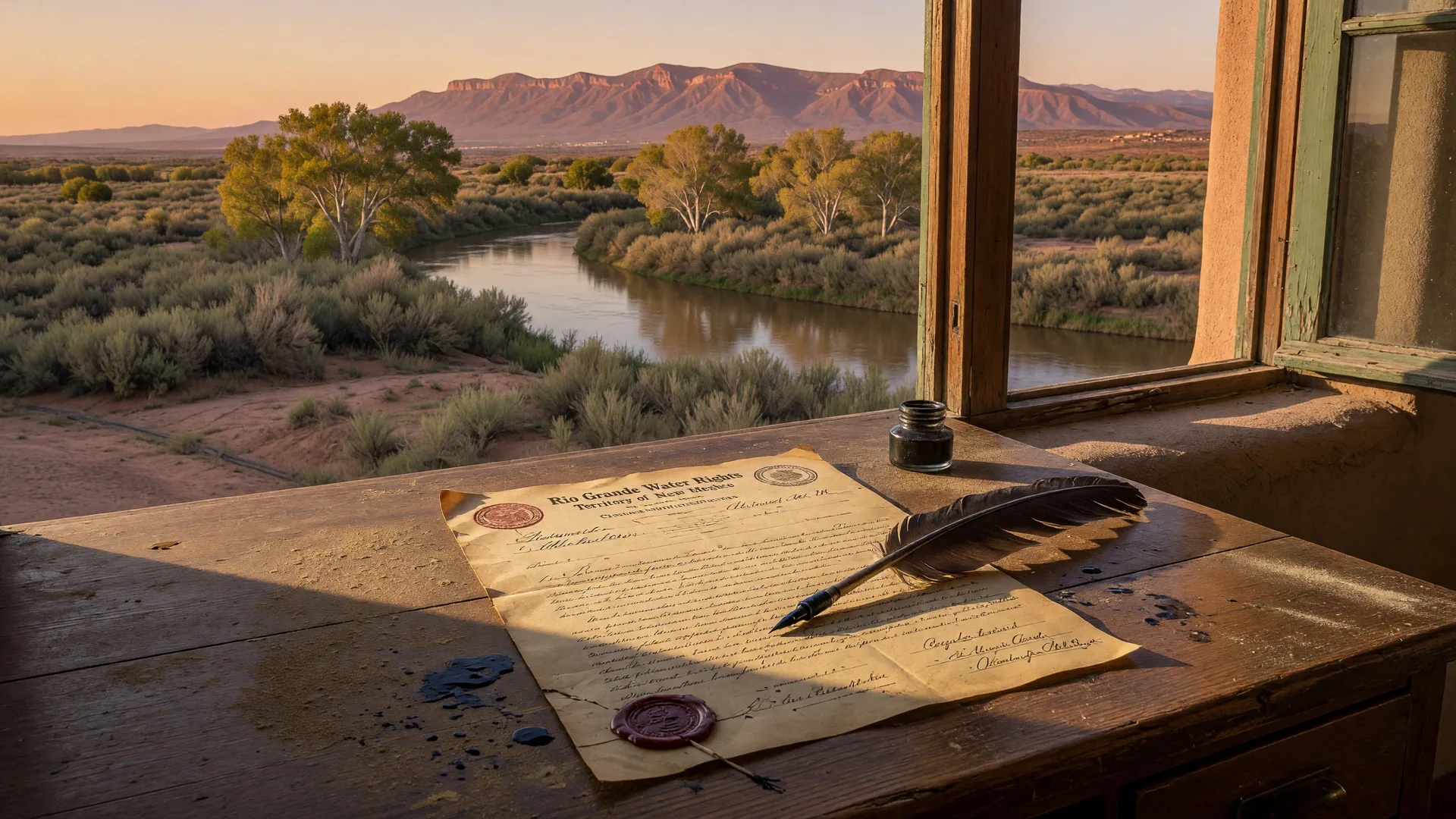

The prior appropriation doctrine is the legal foundation of every water right in New Mexico. It determines who has the right to use water, how much they can use, and how those rights are prioritized during shortages. If you are buying, selling, or owning property in New Mexico, understanding this doctrine is not optional. It is essential knowledge that directly affects property value, water security, and your legal rights as a landowner.
This guide explains the prior appropriation doctrine in plain language: what it is, how it works, and why it matters for real estate in Albuquerque, Rio Rancho, Corrales, Placitas, and every community across the state. For a broader overview of water rights, visit our New Mexico Water Rights resource page and the companion post What Are Water Rights in New Mexico?
1. What Is the Prior Appropriation Doctrine?
The prior appropriation doctrine is the legal framework governing water rights in New Mexico and most western states. Its core principle is simple: "First in time, first in right." The person who first put water to beneficial use has the senior right to that water, and they hold priority over anyone who established a right later.
This means that water rights are not tied to land ownership along a water source, as they are in eastern states. Instead, they are independent legal rights with their own priority dates, quantities, and permitted uses. The doctrine was developed in the arid western United States during the 19th century, where the simple rule of "first come, first served" made practical sense in a water-scarce environment.
In New Mexico, the prior appropriation doctrine has been the law since territorial days. It applies to both surface water (rivers, streams, acequias) and groundwater (wells and aquifers), though the specifics of how it is administered differ between the two. The doctrine is enforced by the New Mexico Office of the State Engineer, which oversees all water rights in the state.
For more detail on how the doctrine applies to surface and groundwater, see our post What Are Water Rights in New Mexico?
2. How It Differs from Riparian Rights
To understand the prior appropriation doctrine, it helps to compare it with the alternative: riparian rights, which are used in most eastern states. The difference is fundamental and explains much of the complexity of water law in the West.
Under riparian rights, landowners whose property borders a water source have the right to use that water. The right is tied to the land itself. If you own property along a river, you automatically have the right to use the water. Rights are shared among all riparian landowners, and during shortages, each user must reduce their use proportionally. This system works well in regions with abundant rainfall where there is usually enough water for everyone.
Under the prior appropriation doctrine, the right to use water is not tied to land ownership along a water source. You must have a legal right to use water, regardless of where your land is located. The right is established by putting water to beneficial use and obtaining approval from the State Engineer. The key distinction: a landowner in the eastern part of Albuquerque or on the West Side may hold water rights that originated from the Rio Grande, even though their land is miles from the river.
In practice, this means that water rights in New Mexico are a separate asset class from the land itself. They can be bought, sold, severed, and transferred independently. While a homeowner on municipal water in Rio Rancho may never interact with this system directly, the prior appropriation doctrine governs every drop of water that flows from the faucet.
3. The Five Elements of a Prior Appropriation Right
For a water right to exist under the prior appropriation doctrine in New Mexico, five elements must be satisfied. Missing any one of them can mean the right does not exist or is not enforceable:
- Intent to appropriate water. The appropriator must demonstrate an intent to take water from a source and apply it to a beneficial use. This intent is typically documented through a filing with the State Engineer, but for pre-1907 rights, it is inferred from the act of putting water to use.
- Diversion of water from the source. The water must be physically diverted from its natural course. This can be done through a ditch, pipe, canal, well, or other means. The diversion must be actual and measurable. In some cases, instream uses may be recognized, but the general rule is that diversion is required.
- Application to a beneficial use. The water must be used for a purpose recognized as beneficial under New Mexico law. Beneficial uses include irrigation, domestic use, municipal supply, stock watering, industrial use, and others. The water cannot be wasted. This is the most important ongoing requirement of a water right.
- Compliance with State Engineer requirements. For post-1907 rights, the appropriator must follow the permitting process established by the Office of the State Engineer. This includes submitting applications, obtaining permits, and complying with any conditions imposed. For pre-1907 rights, compliance is demonstrated through continuous beneficial use.
- Priority date established. The priority date is the date when the water right was first perfected. It is the most important attribute of the right because it determines the order of allocation during shortages. The earlier the priority date, the more senior the right.
If a water right lacks any of these elements, it may be invalid, unenforceable, or subject to challenge. This is why professional due diligence is so important when buying property with water rights. For a complete due diligence checklist, see our New Mexico Water Rights resource page.
4. Beneficial Use -- The Cornerstone
Beneficial use is the cornerstone of the prior appropriation doctrine. Under New Mexico law, a water right exists only if the water is being put to a beneficial use. If you stop using the water, you may lose the right. This is known as the "use it or lose it" principle, and it is one of the most important aspects of water law in the state.
Beneficial uses recognized in New Mexico include:
- Irrigation -- the most common beneficial use, covering agricultural crops, pasture, orchards, and gardens
- Domestic use -- drinking, cooking, bathing, and sanitation for households
- Industrial use -- manufacturing, processing, mining, and other commercial applications
- Stock watering -- providing water for livestock, including cattle, horses, and sheep
- Municipal supply -- water provided by cities and water utilities to residential and commercial customers
- Other recognized uses -- including recreation, fish and wildlife, and power generation
The requirement of beneficial use has real consequences. If a landowner holds a pre-1907 irrigation right but has not irrigated for several years, the right may be considered abandoned. The State Engineer can initiate proceedings to declare the right forfeited. This is why water rights due diligence should always include verification that the right has been exercised continuously.
For more on domestic well permits and their limitations, see our post Domestic Wells vs. Irrigation Rights in New Mexico.
5. How Priority Dates Work
The priority date is the single most important attribute of any water right under the prior appropriation doctrine. It is the date when the right was first perfected by putting water to beneficial use. Senior rights holders -- those with the earliest priority dates -- get water first during shortages. If there is not enough water for everyone, junior rights holders may receive nothing.
Here is how priority works in practice. Imagine three water users on the same stream: User A has a priority date of 1875, User B has a priority date of 1920, and User C has a priority date of 1985. During a normal water year, all three users receive their full allocation. During a drought when only 60 percent of the usual flow is available, User A (1875) receives their full allocation first. Then User B (1920) receives whatever is left. User C (1985) receives only what remains after the senior rights are satisfied. In severe drought, User C may receive nothing at all.
This is why properties with senior priority dates -- especially pre-1907 rights -- command premium prices. The security they offer during drought is invaluable, and buyers who understand the priority system are willing to pay for it.
For more on pre-1907 rights and why they are the gold standard of water security, see our post Understanding Pre-1907 Water Rights in New Mexico.
6. Pre-1907 Rights in New Mexico
Before 1907, water use in New Mexico was largely unregulated. Anyone who put water to beneficial use -- irrigating crops, watering livestock, or powering a mill -- established a water right simply by using it. There were no permits, no filings, and no Office of the State Engineer to oversee the process. Rights established during this period were "grandfathered" in when the formal permitting system began in 1907.
These pre-1907 rights hold special senior status under the prior appropriation doctrine. They are the oldest, most senior rights in the state, and they are extremely valuable. A pre-1907 right has survived more than a century of legal scrutiny, adjudication proceedings, and water administration. It is as close to ironclad as a water right gets.
Properties with pre-1907 rights are concentrated in areas where irrigation and agriculture were established earliest: the Middle Rio Grande valley (including Corrales, Los Ranchos de Albuquerque, the North Valley, and Socorro), the Pecos River valley, and the acequia communities of northern New Mexico. If you are buying property in one of these areas, understanding the pre-1907 water rights situation is essential.
For a complete guide to pre-1907 rights, including how to verify them, read our dedicated post Understanding Pre-1907 Water Rights in New Mexico.
7. How This Affects Real Estate
The prior appropriation doctrine has direct, practical implications for anyone buying or selling property in New Mexico. The most important one: the land and the water rights are separate legal entities. A property without water rights -- or with junior rights -- may not be what it seems.
When you buy property in New Mexico, you must verify the water rights attached to the property. The deed must specifically state that water rights are being conveyed. A water rights attestation should be included in the transaction documents to confirm whether rights are included, severed, or subject to any prior transfers. Without this verification, you could close on a property that looks like it has water but legally does not.
The implications go beyond the transaction itself. A property with strong, senior, adjudicated water rights holds significantly more value than one without. The water rights themselves can represent 30 to 50 percent of the total property value on agricultural and ranch land. On the other hand, a property with severed rights, junior rights, or unclear documentation is a risk that lenders, appraisers, and informed buyers will discount accordingly.
For a detailed breakdown of how water rights affect property values, including real-world examples, read our post How Water Rights Affect Property Values in New Mexico.
8. The Role of the State Engineer
The New Mexico Office of the State Engineer (OSE) is the primary state agency responsible for administering the prior appropriation doctrine. Created in 1907, the OSE oversees all water rights in the state -- issuing permits, maintaining records, and adjudicating disputes. Their records are the primary source for verifying water rights before buying a property.
The State Engineer's responsibilities include:
- Issuing water rights permits for new appropriations, changes in use, and transfers of existing rights
- Maintaining the water rights database -- the official record of all permitted and adjudicated rights in the state
- Administering priority during shortages -- determining which rights are curtailed and in what order
- Adjudicating water rights -- participating in court proceedings that confirm the existence, scope, and priority of water rights
- Enforcing water law -- investigating unauthorized use, waste, and violations of water rights permits
For buyers and sellers, the OSE database is the starting point for any water rights due diligence. The agency provides public access to water rights records through its online system, and you can request file reviews for specific properties. However, the database can be complex and incomplete for older rights, which is why professional guidance is often necessary.
9. What Happens During Drought?
Drought is where the prior appropriation doctrine becomes most visible and most consequential. During severe drought, the doctrine is enforced strictly. Senior rights holders receive their allocation before junior holders. In extreme cases, junior rights holders may receive nothing for an entire season.
The process is called priority administration. When the State Engineer determines that there is not enough water to satisfy all rights, they issue orders curtailing (shutting off) the most junior rights first. As conditions worsen, more senior rights may also see reduced allocations. In practice, pre-1907 rights are rarely curtailed. Rights established in the 1980s or later are the most vulnerable.
For agricultural landowners, the difference between a senior and a junior water right during drought can mean the difference between a productive growing season and a total loss. For ranches, it can mean the difference between keeping livestock and being forced to sell. For residential properties with domestic wells in fully appropriated basins, it can mean the well going dry in the middle of summer.
This is why the priority date matters so much. A property with a pre-1907 right or another senior priority date offers water security that a property with a junior right simply cannot match. As drought conditions become more frequent and severe across the Southwest, the value of that security is only going to increase.
For more on how the prior appropriation doctrine interacts with drought planning and water management, visit our New Mexico Water Rights resource page.
10. Why This Matters for Buyers and Sellers
Understanding the prior appropriation doctrine helps you evaluate the true value and security of a property's water rights. It is the foundation of every water transaction in New Mexico, and it affects almost every aspect of a real estate deal involving water.
For buyers, understanding the doctrine helps you ask the right questions before making an offer: Does the property have water rights? What is the priority date? Are the rights adjudicated or unadjudicated? Have the rights been continuously exercised? Will the rights transfer with the property? The answers to these questions determine whether the property can sustain its intended use and whether the asking price is fair.
For sellers, understanding the doctrine helps you position your property accurately. If you have strong, senior water rights, that is a significant selling point. If the rights are junior, severed, or unadjudicated, you need to be transparent about the limitations so buyers can make informed decisions. A seller who understands the water rights can confidently answer buyer questions and avoid last-minute deal killers.
The prior appropriation doctrine is not academic. It is the legal reality that governs every property in New Mexico that has water rights. Understanding it is not optional for serious buyers and sellers. It is the foundation upon which water security, property value, and successful real estate transactions are built.
For a comprehensive due diligence checklist and more information about water rights in New Mexico real estate, visit our New Mexico Water Rights resource page.
Understanding water rights is essential before any property transaction in New Mexico. Let us help you evaluate the water picture.
Contact Nysha Lynn Livingston at 505-218-1851 or NyshaSellsRE@gmail.com.
Also explore: water rights overview · pre-1907 rights guide · contact Nysha